 Lincoln Egress Windows
 Window Well Installation in Lincoln
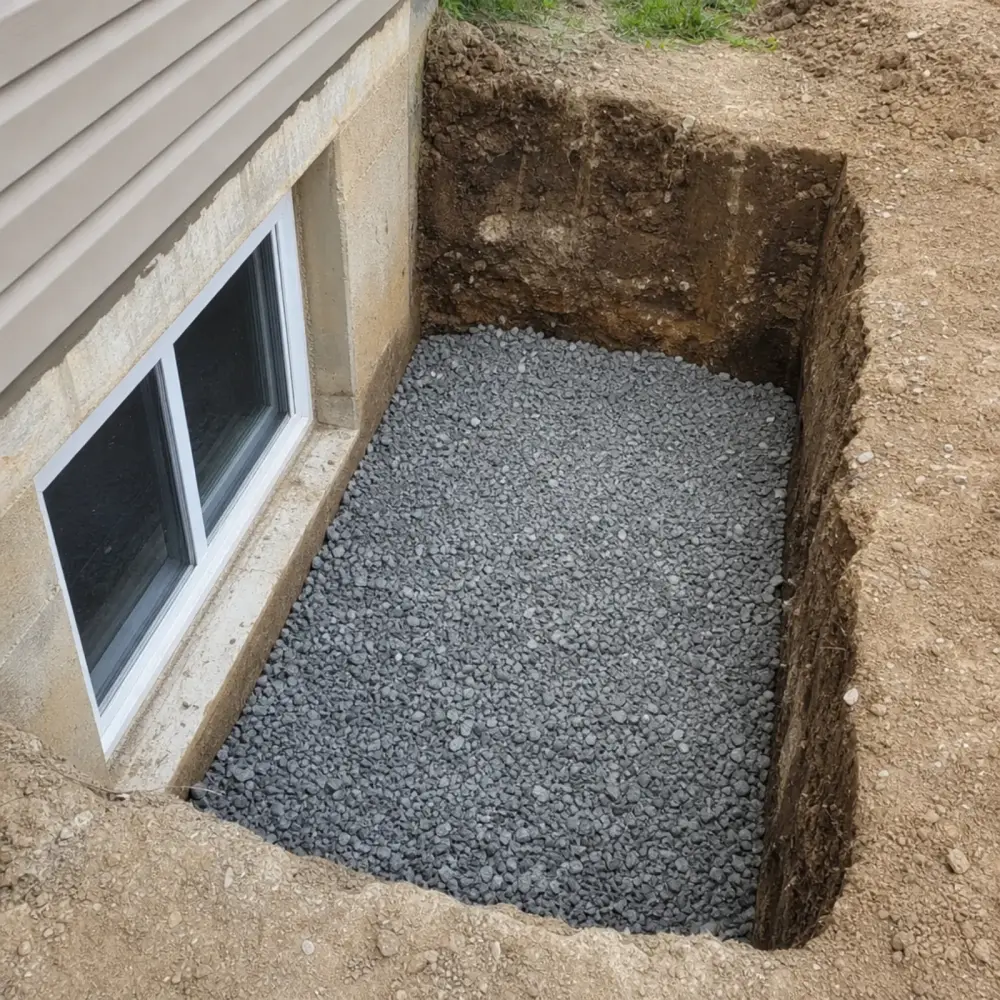
Lincoln Egress Windows installs and replaces window wells across Lincoln - code-sized wells with anchored ladders and real gravel drainage, whether the well serves a brand-new egress opening or replaces a rusted original that’s been holding water since spring. Well replacement at an existing opening typically runs $1,000–$3,000; wells included in a full egress install are priced into that job’s flat quote.
A window well looks like the simple part of an egress system. It’s where most of the failures happen. The code tells you the minimum geometry; Lincoln’s soil and freeze-thaw cycle decide whether the well actually works for the next twenty years.
What code requires - and why each number exists
For an egress opening below grade, the well must provide:
- At least 9 square feet of horizontal area, with minimum 36 inches of width and 36 inches of projection from the foundation wall - enough room for an adult to stand in the well and open the window fully, or for a firefighter in gear to climb down and in.
- A permanently attached ladder or steps when the well is deeper than 44 inches - rungs at least 12 inches wide, projecting at least 3 inches from the wall, spaced no more than 18 inches on center. “Permanently attached” means bolted, not a garden ladder leaned in the corner.
Lincoln wells almost always cross the 44-inch line. The city’s code sets frost depth at 42 inches, sills sit low on full-depth basements, and a proper drainage bed adds depth below the sill - so plan on a 5-foot well and a ladder. The window inside the well has its own numbers (5.7 square feet net clear - Lincoln allows no grade-floor reduction), covered on the egress installation page.
Lincoln’s real enemy: water, then frost
Dig a hole beside a foundation in Lancaster County’s clay-heavy soil and you’ve built a place for water to collect - unless the water is given somewhere to go. A well install that lasts here has three layers of defense:
1. A drainage bed, not a dirt floor. A deep bed of washed gravel under the well, tied into the footing drain tile if the house has one. Most Lincoln homes built since the 1970s do; many older homes in the Near South, University Place, and College View don’t, and there the answer is a deeper gravel dry well that gives water storage and a path down instead of in. Which one your house needs is determined at the free measure, not guessed.
2. Anchoring to the foundation. The well bolts to the concrete, not to the soil. Backfilled clay expands, contracts, and heaves with frost - a well anchored only by backfill pressure gets pushed off the wall a little every winter until daylight (and water) shows at the seam. Failed anchoring is a common defect on existing Lincoln wells.
3. Grade and cover. Backfill compacted in lifts and finished grade sloping away from the house, so surface water never aims at the well in the first place - settled backfill that’s sunk into a bowl around the foundation is standard on homes 5–15 years old, including plenty in the newer subdivisions south of Yankee Hill Road. A polycarbonate cover keeps rain, leaves, and snow out while staying light enough to push open from inside. Covers and drainage retrofits have their own page.
Material choices, priced honestly
| Well type | Typical installed cost (replacement) | The honest take |
|---|---|---|
| Corrugated galvanized steel | $1,000–$1,700 | The workhorse. Meets code, lasts decades if anchored and drained right. |
| Composite / structural plastic | $1,500–$2,500 | No rust, cleaner look, often stackable for depth. |
| Stone-texture / terraced | $2,000–$3,000+ | The one you pick when a finished bedroom looks at it every day. |
The well is the view from a basement bedroom window. On a basement finish where the room is the point, spending up on the well and a clear cover buys real daylight; on a rental or a pre-listing fix, galvanized steel with correct drainage is the smart money.
Common problems in Lincoln’s existing wells
The diagnostic patterns sort neatly by housing era. Pre-war and early post-war neighborhoods - Near South, Havelock, University Place, College View - have wells that were improvised decades ago: shallow half-moons of rusted corrugated steel, brick rings, sometimes poured curbs with no drainage thinking at all, guarding openings that predate the egress concept entirely. The mid-century ranch belt has original steel wells at end-of-life, rusted through at the anchor bolts. And the newer subdivisions have code-correct wells suffering from exactly one thing: backfill that settled into a grade sloping toward the house. Three eras, three failure modes, one common denominator - water with nowhere to go. The measure identifies which story your well is telling before anyone quotes a fix.
Replacement, step by step
A standalone well replacement is a one-day job in most cases: excavate around the failed well, pull it, dig the drainage bed down to clean gravel depth, set the new well level and bolt it to the foundation with masonry anchors, install the ladder if depth requires it, then backfill in compacted lifts and re-grade away from the house. No concrete cutting, and usually no permit - though if the window opening changes size or the room is becoming a bedroom, the full code scope applies and we’ll tell you so before quoting.
If your well problem is really a window problem - rotted frame, fogged glass, a unit that won’t open - a basement window replacement in the same dig is the efficient fix. And if you’re not sure what’s failing, that’s exactly what the free on-site measure answers: send the form with a photo of the well, and we’ll bring the tape, check the anchoring and the drainage, and quote you a flat number - with the full price sheet already public, so you can check us against it.
Frequently Asked Questions
What size does a window well have to be in Lincoln?
For an egress window, the well must provide at least 9 square feet of horizontal area with a minimum 36 inches of width and 36 inches of projection from the foundation. If the well is deeper than 44 inches - most Lincoln egress wells are - it needs a permanently attached ladder or steps: rungs at least 12 inches wide, projecting 3 inches from the wall, spaced no more than 18 inches apart.
How much does a window well replacement cost?
Replacing a well at an existing opening typically runs $1,000–$3,000 in Lincoln. Corrugated galvanized steel is the value end; composite and stone-texture wells cost more and look considerably better from a finished basement window. Depth, drainage work, and access move the number.
Why does my window well fill with water?
Almost always one of three missing pieces: no gravel drainage bed under the well (or one that's silted shut), grading that sends surface water toward the house instead of away, or a well that was never tied into the footing drain tile. Lincoln's clay-heavy soils don't drain on their own - the well needs an engineered path for water, not hope.
Do rusted steel wells need full replacement?
Not always. If the steel is structurally sound and the problem is water or appearance, drainage work and a cover may solve it for less. But once corrugated steel rusts through at the anchor points or the soil is pushing it off the wall, replacement is the honest recommendation - a collapsing well is a safety problem, not a cosmetic one.
Can you replace a well without touching the window?
Yes - that's the standard well replacement job: excavate around the existing well, remove it, rebuild the drainage bed, set and anchor the new well, backfill and grade. If the window itself is failing too, doing both in one dig saves real money over two separate projects.